
 Deutsch
 English

DFG-funded research project
Today, global illumination is usually simulated using Monte Carlo methods, whereby the integral equation is solved step by step by generating random paths. Thanks to the ray tracing hardware that has been available for some years, these methods have become partially real-time capable. On the other hand, there are many fast, rasterization-based methods for real-time capable, global illumination. This raises the question of whether a suitable combination of the two approaches can achieve an acceleration of the representation. The aim of the project is therefore the optimal combination of ray tracing and rasterization, so that no visible changes in the image of a global illumination are recognizable, but a significant acceleration of the representation is achieved. In the Monte Carlo simulation, suitable rasterization techniques are to be used selectively along a random path. In addition, a purely rasterization-based real-time illumination with a geometry buffer is to be selectively supported by a ray tracer.
Stenciled Volumetric Ambient Occlusion
Felix Brüll, René Kern and Thorsten Grosch
Eurographics Symposium on Rendering (EGSR 2022)
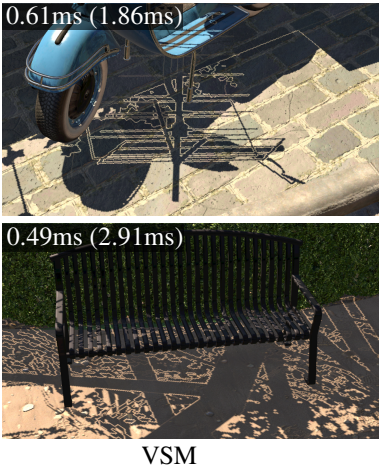
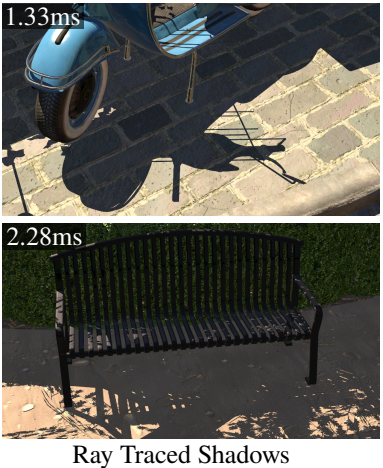
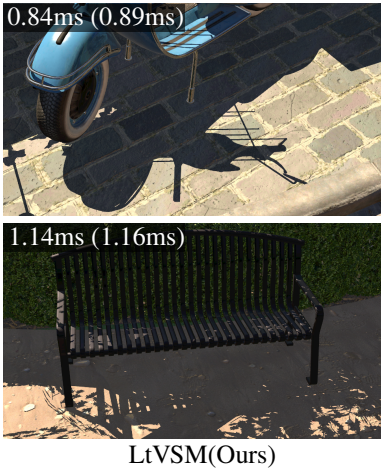
Real-Time Pixel-Perfect Hard Shadows with Leak Tracing
René Kern, Felix Brüll and Thorsten Grosch
Eurographics Symposium on Rendering (EGSR 2024)
Ray Traced Stochastic Depth Map for Ambient Occlusion
Felix Brüll, René Kern and Thorsten Grosch
Eurographics Symposium on Rendering (EGSR 2024)
The virtual microscope - visualization and inspection of the geometry of simulated particle debris
SWZ-funded research project
Project partner: Prof. Dr. Michael Kolonko, Clausthal University of Technology
Many materials and substances are made up of particles, from concrete to tablets. Some properties of the finished materials are already strongly determined by the geometric properties of the particle mixtures. In the case of concrete, for example, the volume of the dry mixture, i.e. the ratio of the container size to the volume of the particles contained, is decisive for the strength of the concrete after curing. In other applications, such as the production of foams, the distribution and shape of the spaces between the 'particles', which in this case are cavities, play a decisive role in the properties of the material.
The right choice of mixture composition and particle size distribution is therefore crucial in the development of particle-based materials with specified properties. Until now, this has usually required complex laboratory experiments, but there have been successful attempts to at least simulate the geometry of the mixtures on the computer. The Kolonko working group has been developing a program system "RaSim" for several years, which simulates the random dense arrangement (packing) of a mixture of spherical particles with a specified grain size distribution (KGV). The main area of application is concrete research, where the search is on for KGVs with the highest possible space filling. As a result, the simulation currently provides the achieved space filling as a percentage and creates static images of simulated packings with standard software.
In order to use the simulation in a broader field of application, such as the production of filters and membranes from particles, but also for the production of mixtures for foundry molds or 3D printing, further qualitative properties of the packings must be determined, e.g. concerning the local interaction of the particles. This is particularly necessary when non-spherical particles are simulated, as is already possible to some extent. The aim here is to recognize the relative position of the (differently shaped) particles to each other and to be able to assess the mixing. This would also make it possible to study the effects of individual parameter settings of the simulation, which in turn correspond to real conditions such as pressure or duration of the mixing process, in more detail.
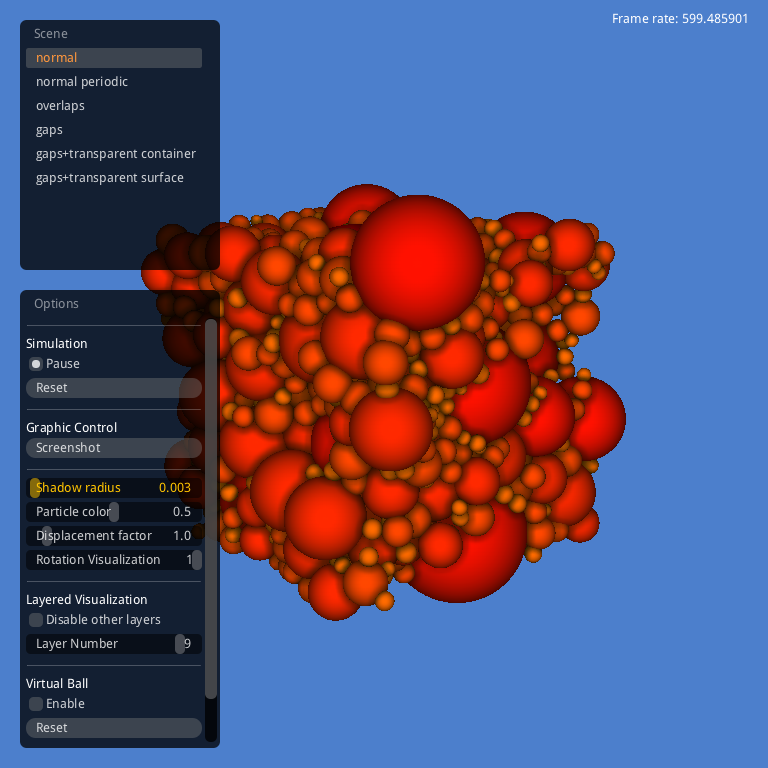
In real mixtures, the arrangement and shape of the gaps can be examined under a microscope, for example, or possible (undesirable) sorting of the particles can be detected. The aim of this project is therefore to develop a flexible visualization tool which, as a kind of virtual microscope, enables intensive qualitative investigations of a simulated mixture. This would extend the range of applications of existing simulation systems and at the same time be an important tool for the further development and improvement of the simulation.
Interactive Visualization of Gaps and Overlaps for Large and Dynamic Sphere Packings
FengGu, Z. Yang, Michael Kolonko, Thorsten Grosch
Vision, Modelling and Visualization (VMV 2017)
Accelerated simulation of sphere packings using parallel hardware
Zhixing Yang, Feng Gu, Thorsten Grosch, Michael Kolonko
Simulation Science (2018)
Fast and Dynamic Construction of Bounding Volume Hierarchies Based on Loose Octrees
FengGu, Johannes Jendersie, Thorsten Grosch
Vision, Modelling and Visualization (VMV 2018)
Accelerating the Visualization of Gaps and Overlaps for Large and Dynamic Sphere Packings with Bounding Volume Hierarchies
FengGu, Zhixing Yang, Michael Kolonko, Thorsten Grosch
Simulation Science (2020)
Visualization and Inspection of the Geometry of Particle Packings
Feng Gu
phd-thesis (2022)
Interacting in Photorealistic Augmented Reality (IPAR)
DFG-funded research project
Project partner: Prof. Dr. Raimund Dachselt, TU Dresden
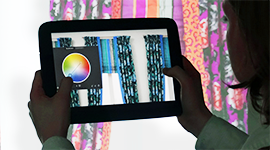
Thanks to mobile devices, augmented reality has the potential to be increasingly used beyond industrial applications in the future. In the field of architecture and interior design, for example, virtual furniture or windows can be placed in real rooms.
In order to manipulate a real world that is as convincingly augmented as possible, photorealistic representations generated in real time as well as natural, seamless forms of interaction with the virtual objects are required. These are two key success factors for augmented reality applications that are being researched in the IPAR project.
The basis is firstly the measurement of the complex, real lighting conditions that are used as input for the real-time illumination of the virtual objects. In addition to changing the real virtual objects, this also enables virtual manipulation of real objects with consistent lighting. On the one hand, indirect techniques are being investigated for the interactions, in which modern tablets held in the hand are used as so-called "magic lenses". Similar to a camera display, they represent a window into the virtually enriched reality through which users can manipulate objects. On the other hand, direct gestural interaction techniques in combination with a mobile projection onto real objects will also be developed and evaluated.
In addition to research questions on measuring and modeling temporally and spatially varying lighting in indoor spaces, the research project is investigating the challenges arising from seamless integration in terms of user interaction and acceptance.

Publications
Tiled Frustum Culling for Differential Rendering on Mobile Devices
Kai Rohmer and Thorsten Grosch
IEEE International Symposium on Mixed and Augmented Reality (ISMAR 2015)
Interactive Near-Field Illumination for Photorealistic Augmented Reality
with Varying Materials on Mobile Devices
Kai Rohmer, Wolfgang Büschel, Raimund Dachselt and Thorsten Grosch
IEEE Transactions on Visualization and Computer Graphics (TVCG 2015)
Interactive Near-field Illumination for Photorealistic Augmented Reality on Mobile Devices
Kai Rohmer, Wolfgang Büschel, Raimund Dachselt and Thorsten Grosch
IEEE International Symposium on Mixed and Augmented Reality (ISMAR 2014)
Best Full Paper Award
Interactive global lighting for large scenes
DFG-funded research project
Global lighting simulations are now possible with high quality, but the ever-increasing size of the scenes poses a problem: The available memory on CPU and GPU is often not sufficient for a complete simulation. This is why out-of-core methods are required that enable these models to be illuminated. In contrast to a simple visualization, in which only the area visible to the current viewer viewpoint is stored in the main memory, the scene areas outside the viewing volume make a decisive contribution to the illumination in global illumination. This project therefore aims to develop strategies for quickly determining the scene regions that are important for global illumination. This should enable interactive illumination of a dynamic scene that does not exhibit any visual artifacts despite a rough representation of the scene stored in the main memory. Furthermore, it should be possible to create a physically correct simulation for still images that corresponds to the state of the art for scenes of normal size in terms of display quality. This applies in particular to complex light paths, which are not possible with current out-of-core lighting methods.
Publications
Distributed Out-of-Core Stochastic Progressive Photon Mapping
Tobias Günther and Thorsten Grosch
Computer Graphics Forum, Volume 33, Issue 6, September 2014
Illumination-driven Mesh Reduction for Accelerating Light Transport Simulations [ Video]
Andreas Reich, Tobias Günther and Thorsten Grosch
Eurographics Symposium on Rendering (EGSR 2015)
Preserving Shadow Silhouettes in Illumination-Driven Mesh Reduction
Florian Bethe, Johannes Jendersie and Thorsten Grosch
Computer Graphics Forum, Volume 39, Issue 6, 2020
Relaxed Parallel Priority Queue with Filter Levels for Parallel Mesh Decimation
Marvin Stümmel, Felix Brüll and Thorsten Grosch
[Honorable Mention] Vision, Modeling and Visualization (VMV 2022)